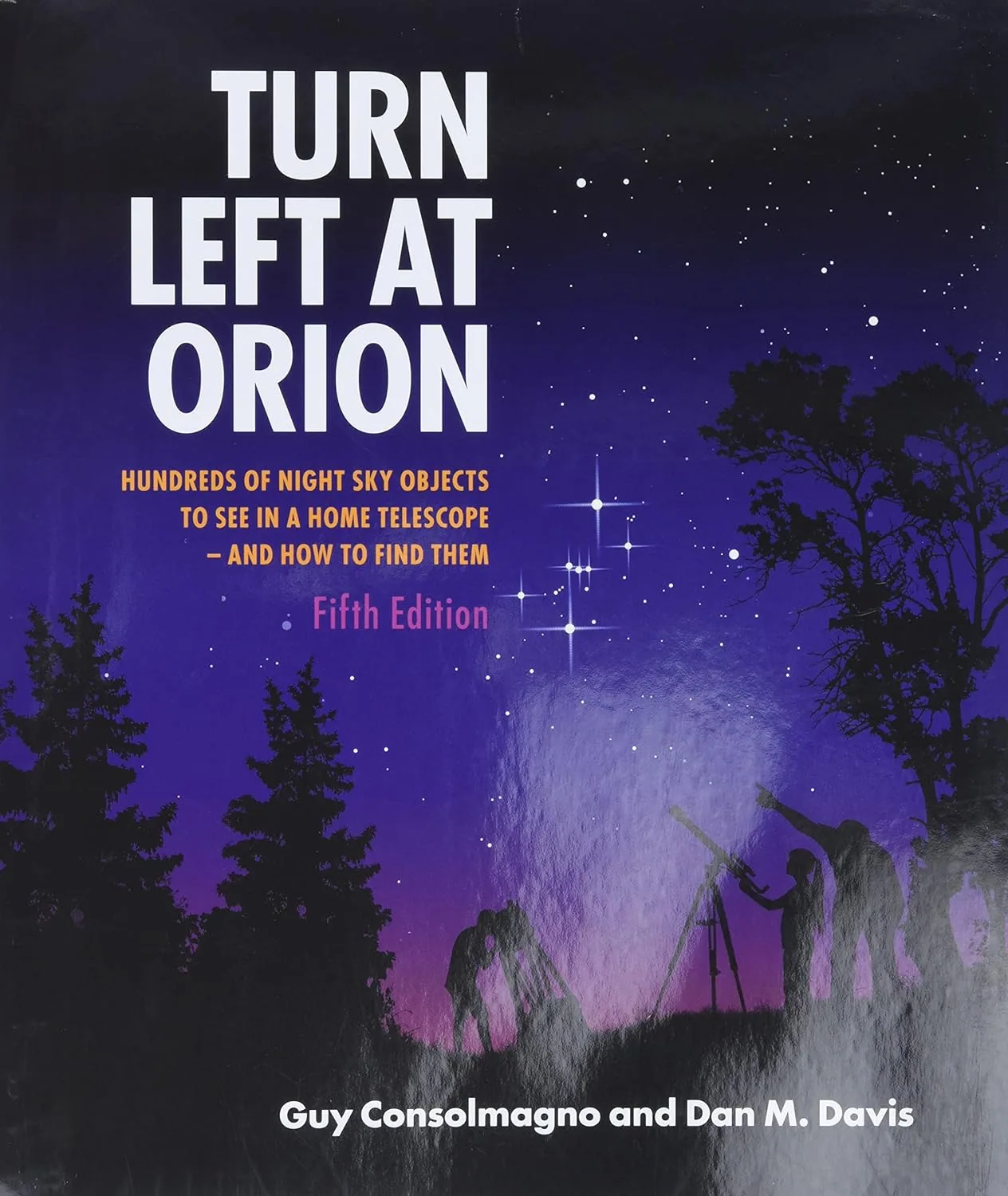
Turn Left at Orion.
The standard recommendation for a reason. Guy Consolmagno walks you through hundreds of objects you can actually see from a back garden, with hand-drawn sketches showing roughly what you will see through a small scope rather than the airbrushed Hubble version.
The single best book to buy when you are learning the sky.
If you've just unwrapped a telescope and have no idea what you're actually looking for on a clear night, this is your book. Turn Left at Orion is arguably the most respected beginner's guide to small-scope observing – and it's been that way since 1989. The difference is simple: instead of showing you what a giant space telescope sees (all that polished Hubble imagery), it shows you what you'll actually see through a modest 3-inch refractor, small Dobsonian, or even binoculars from your garden.
The heart of the book is hundreds of objects mapped out across four seasons, plus Southern Hemisphere targets. For each object, you get three maps: a wide-field finder chart to locate it in the sky, a finderscope view, and a hand-drawn sketch of what you'll see in your eyepiece. The sketches are honest – sometimes quite faint, sometimes surprisingly detailed – which builds genuine confidence when you finally track down the Orion Nebula or a distant galaxy yourself. The writing is friendly and free of jargon, and every object comes with practical notes: which eyepiece power works best, whether you need dark skies, even a "wow factor" rating so you know what's actually worth the hunt.
One practical heads-up: this is a substantial spiral-bound hardback (about 2.3 kg), designed to lie flat outside. You'll want somewhere to rest it – a table, an observing log, or a book stand – rather than juggle it with a red torch while you're at the eyepiece. If storage space is tight at home, or your observing site doesn't have a flat surface nearby, that's worth considering. It's also primarily Northern Hemisphere focused, which is perfect for the UK, though it does include some Southern Hemisphere targets too.
The book assumes zero prior knowledge of astronomy. If you're comfortable with a finderscope and basic star-hopping, you're ready. It pairs brilliantly with a simple red torch and a planisphere – and once you've used it a few times, you'll understand why every astronomy club and experienced observer recommends it to friends starting out.
Honest expectations, first night out.
Tonight
A clearer answer to what is worth looking for before you step outside.
The sky
Constellations, seasonal targets and beginner terms start to join up.
Progress
You build a habit of finding things yourself rather than just recognising names.
What we love, what is worth knowing.
- ✓Sketches match what you actually see, not what a giant telescope sees
- ✓Plain, friendly language throughout
- ✓Covers Northern Hemisphere targets, perfect for the UK
- ✓Spiral binding lies flat outside
- !Bigger and heavier than a paperback, you will need a table
Be honest with yourself.
The single best book to buy when you are learning the sky.
You prefer learning entirely through apps and short articles.
Specifications.
Straight from the stargazers.
It's very useful for understanding the very basics: how the sky moves, telescope views, effects of atmosphere, etc.
After tinkering with a 76mm scope for six months, this book showed me what I was missing and gave me confidence.
Rung 02.
Related picks.
Useful background before you buy.
- Turn Left at Orion ReviewAstronomy Trek
When you buy through the links on this page we may earn a small affiliate commission, at no extra cost to you. It helps keep Astro for Beginners beginner-focused and ad-light. We only ever recommend kit we would genuinely buy ourselves. Amazon UK link
Back to all gear